WATCH THE MASTERCLASS

For a woman, money is never just about money. It's tangled with whether she's safe, what she's allowed to have or want, and who gets a say, even when she's the one who earned it.
My mother left Mexico when she reached the limit of what hard work could make possible there. She needed to provide for us and wanted more for all of us. So she went to America without us to create access we couldn't have had there.
When I was twelve, my brother and I immigrated to join her and stepped into everything she'd created for us. Overnight, I had all the food I could eat, clothes that weren't hand-me-downs, Barbie dolls, an allowance, and indoor plumbing. It was a middle-income American life, but compared with my life in Mexico, I thought I was rich.
I could see what my mother had done. I wouldn't understand until years later what it cost her, what she compromised, or what she endured to give us that life.
What stayed with me was money's power to change a life. At eighteen, I watched it start changing mine. As a server, I made more in a few shifts than my mother made in a week, even with her college degree. Making money quickly while having fun led me to commission-based sales, then my own business. It was feast or famine for quite a while, and it was scary as hell, but it was what I wanted.
My mother had gone first and brought me as far as she could. She taught me how to work hard. She couldn't teach me what to do with money that showed up one month and disappeared the next. That part I had to figure out as I went.
I learned how to make money long before I learned how to live with it.
Making it was the easy part. Using it, planning with it, and building security with it were completely foreign to me. As a single mother, I needed money to be something my children and I could count on. Someone once told me, "I hate that you had to learn so much of this the hard way." Honestly, so do I.
For a lot of women, having more money doesn't come with knowing what to do with it or feeling free to decide what happens next.
The money may be hers. Learning to live with everything attached to it is hers too.
Money carries more than purchasing power.
In a woman's life, it can become authority, and nobody has to announce it. Like most authority, it settles into the foundation of things until it feels like the natural order.Her financial position can change. That doesn't automatically change who has the final say or who's obligated to whom.
Money promises freedom, safety, and choice, and it can deliver all three. What it doesn't promise is that the expectations around her change at the same speed her bank account does.
It's easy to make money the villain in this story, but it isn't. It just gives old rules and expectations something to operate through.
Money carries more than purchasing power.
In a woman's life, it can become authority, and nobody has to announce it. Like most authority, it settles into the foundation of things until it feels like the natural order.
Her financial position can change. That doesn't automatically change who has the final say or who's obligated to whom.
Money promises freedom, safety, and choice, and it can deliver all three. What it doesn't promise is that the expectations around her change at the same speed her bank account does.
It's easy to make money the villain in this story, but it isn't. It just gives old rules and expectations something to operate through.

The number in a bank account can have a lot of say in a woman's decisions. For women, that number has too often been smaller.
In 2025, 11.1 percent of women in the United States lived below the official poverty line, compared with 9.2 percent of men. That comes to nearly four million more women than men. An analysis of 2024 Census data found even higher poverty rates among women of color, including 17.8 percent for Black women, 15.2 percent for Latinas, and 19.4 percent for Native women.
That inequality reaches directly into children's lives. In 2025, four out of every ten children under the age of six living in families headed by a woman with no spouse present lived below the poverty line.
The earnings data shows that the gap doesn't close just because women are working. Among people who worked full time, year-round in 2025, women's median earnings were 83.9 percent of men's. Research on immigrant workers shows that a credential earned in another country, a language barrier, or licensing rules can limit the work a woman can get before pay even comes into play.
These numbers estimate how many women are living this way. They can't tell us what goes unreported or everything those conditions have required of them. What they can tell us is that women have had less money to make choices with, and some have had much less.
That's how money can hold power over a woman's life long before she has enough of it to feel powerful.
The number in a bank account can have a lot of say in a woman's decisions. For women, that number has too often been smaller.
In 2025, 11.1 percent of women in the United States lived below the official poverty line, compared with 9.2 percent of men. That comes to nearly four million more women than men. An analysis of 2024 Census data found even higher poverty rates among women of color, including 17.8 percent for Black women, 15.2 percent for Latinas, and 19.4 percent for Native women.
That inequality reaches directly into children's lives. In 2025, four out of every ten children under the age of six living in families headed by a woman with no spouse present lived below the poverty line.
The earnings data shows that the gap doesn't close just because women are working. Among people who worked full time, year-round in 2025, women's median earnings were 83.9 percent of men's. Research on immigrant workers shows that a credential earned in another country, a language barrier, or licensing rules can limit the work a woman can get before pay even comes into play.
These numbers estimate how many women are living this way. They can't tell us what goes unreported or everything those conditions have required of them. What they can tell us is that women have had less money to make choices with, and some have had much less.
That's how money can hold power over a woman's life long before she has enough of it to feel powerful.
Money is never neutral. It's a stand-in for how much a woman is allowed
to want, have, keep, or enjoy before it becomes too much.
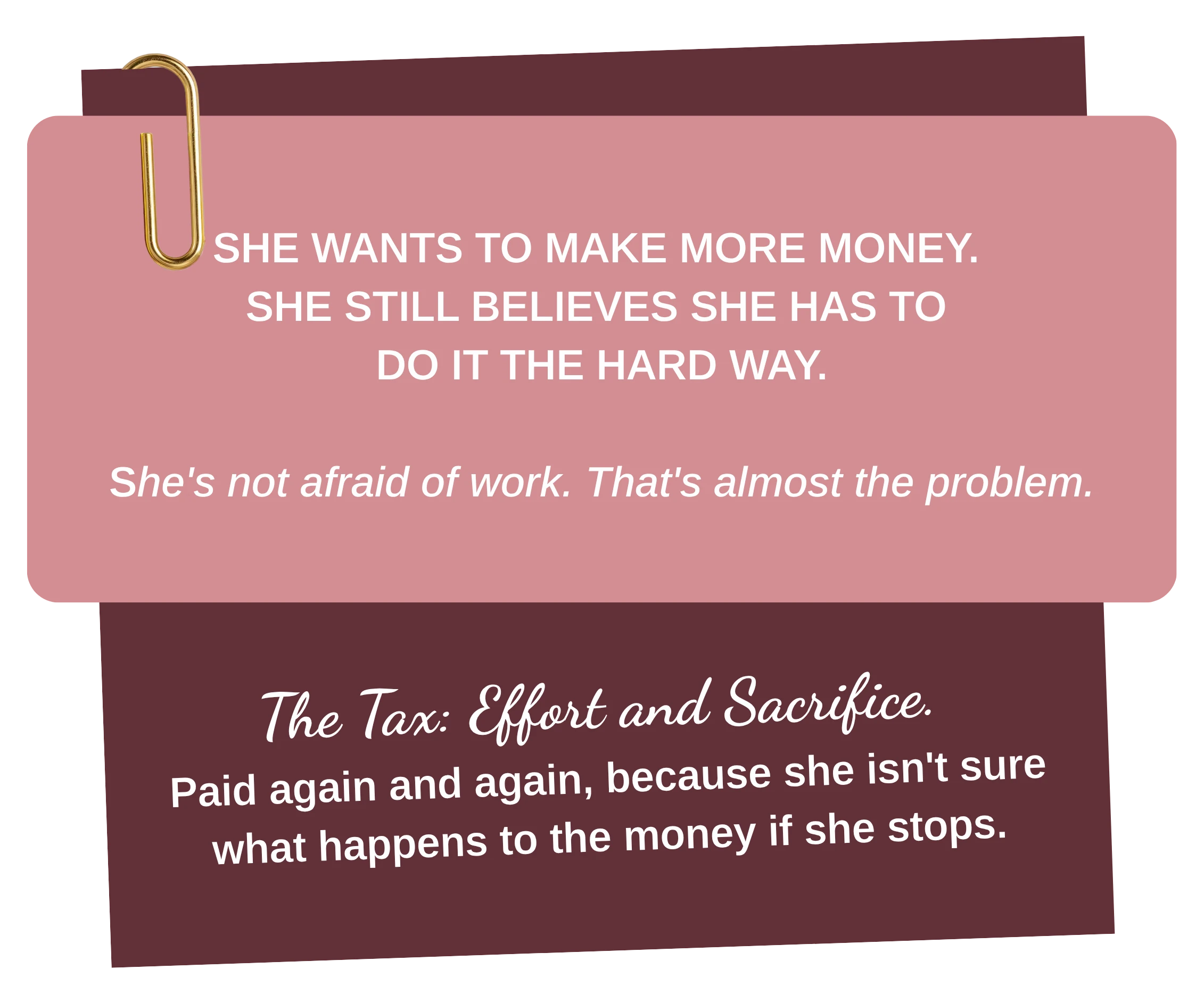

Assuming every extra dollar has to come from extra hours.
Feeling like she'll fall behind the moment she stops pushing.
Still feeling pulled toward doing more, even after she's shown she can do the job.
Working longer, trying harder, staying later, and never really switching off.
Believing the money only counts once she's suffered enough to earn it.
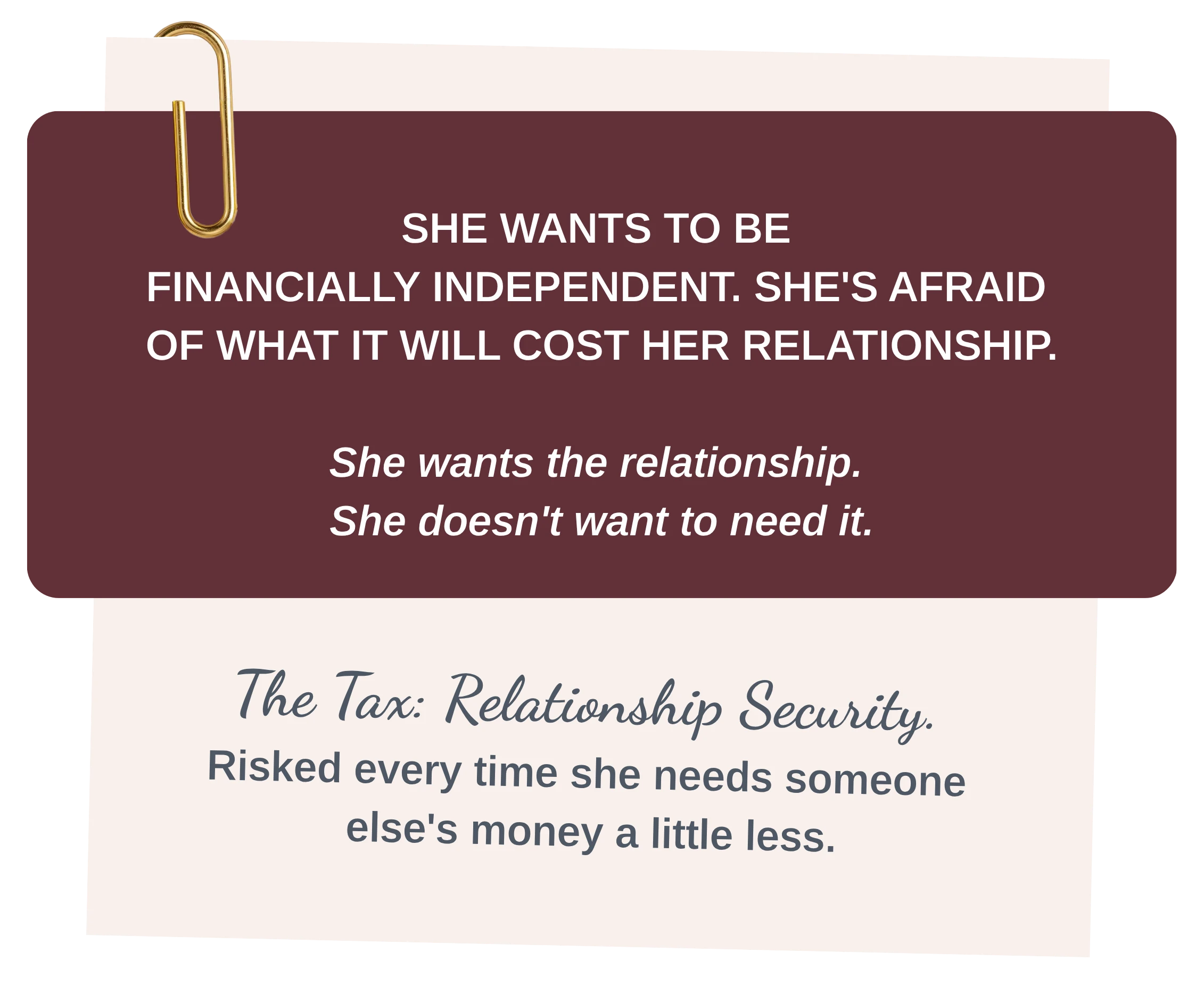
Asking herself if she'd still be in the relationship if money weren't part of the equation.
Resenting how dependent she feels and fearing what happens once she isn't.
Wanting to be able to support herself and feeling guilty for the support she still receives.
Deferring the final say to whichever one of them makes more money.
Wanting to know she could leave, and wondering what would happen if she really could.
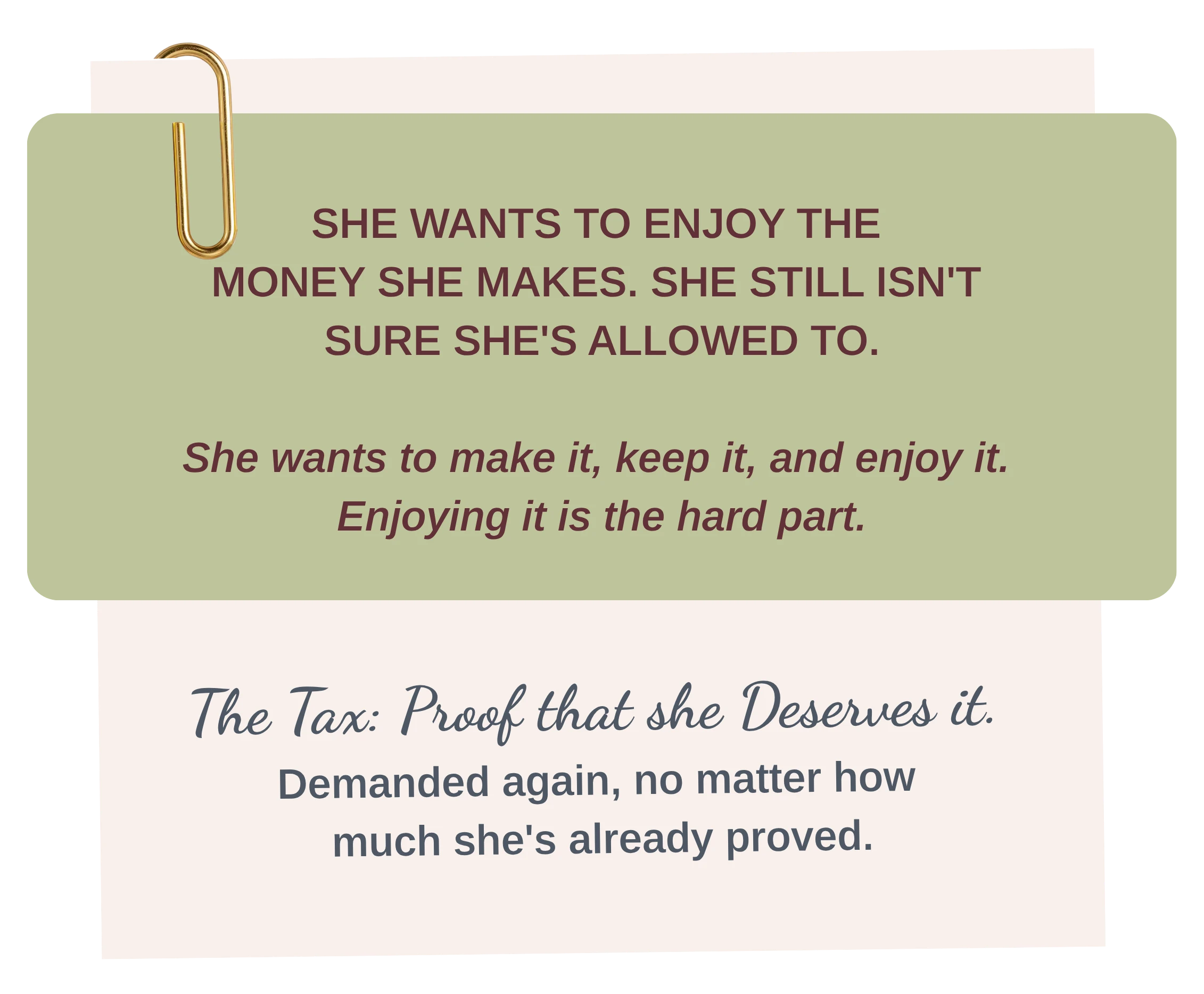

Needing a good enough reason before she lets herself want more.
Reminding herself how hard she worked, just to feel okay about the money she's made.
Wondering what it says about her if money makes her life this much easier.
Believing she doesn't deserve the money unless she's done something good with it.
Holding herself back from enjoying it when people she loves go without.
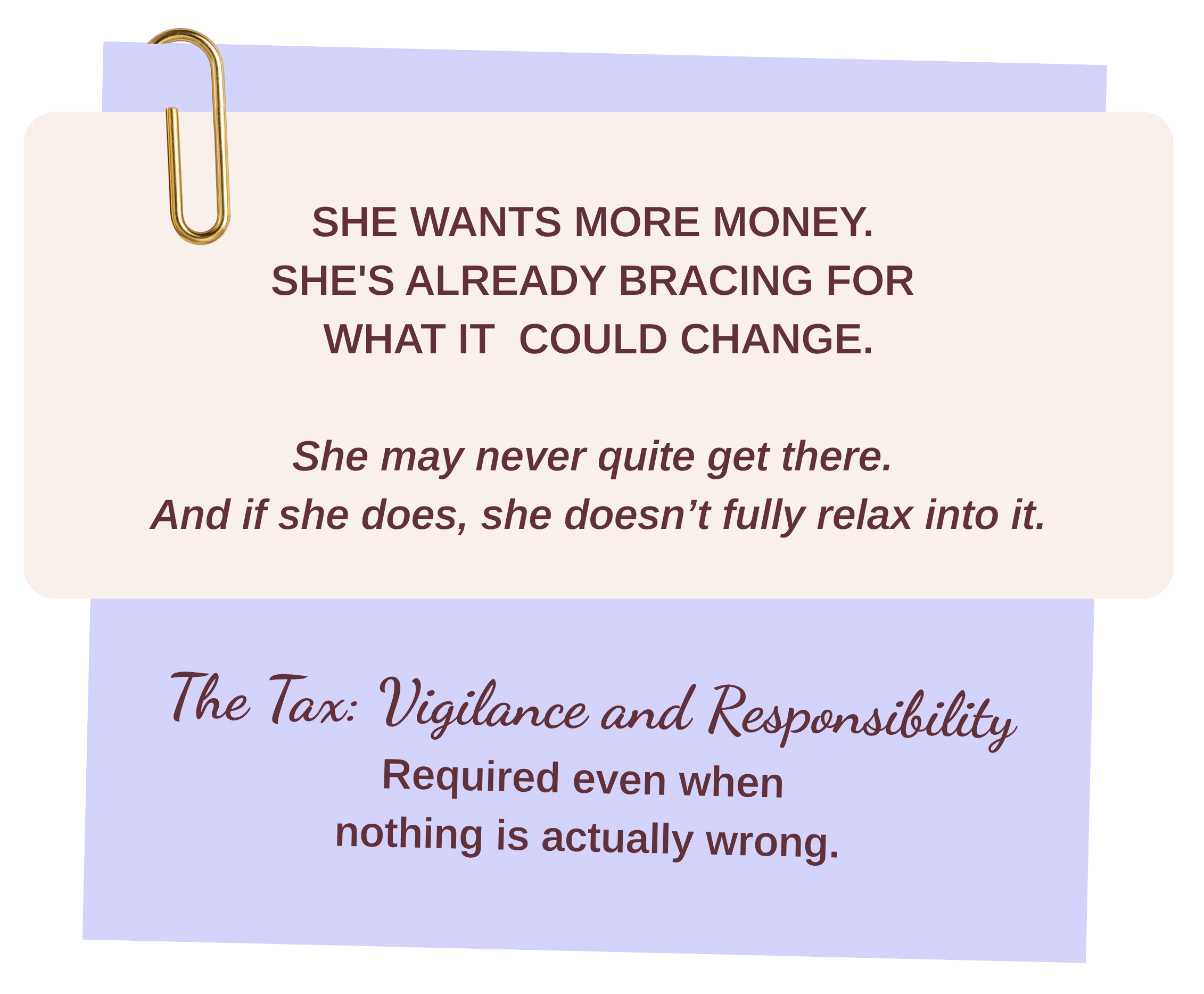

Worrying about what she'll be responsible for before she even has it.
Finding twelve reasons not to take the opportunity that scares her the most.
Deciding immediately what the new money needs to do, before she's let herself enjoy it.
Treating every unfamiliar part of having more like a risk to manage.
Wondering if she'll know how to handle a life with plenty of money in it.
Money doesn't just change her income.
It changes what she has to prove, what people expect from her,
and how much of herself she has to give to keep it.

Money is never neutral. It's a stand-in for how much a woman is allowed
to want, have, keep, or enjoy before it becomes too much.
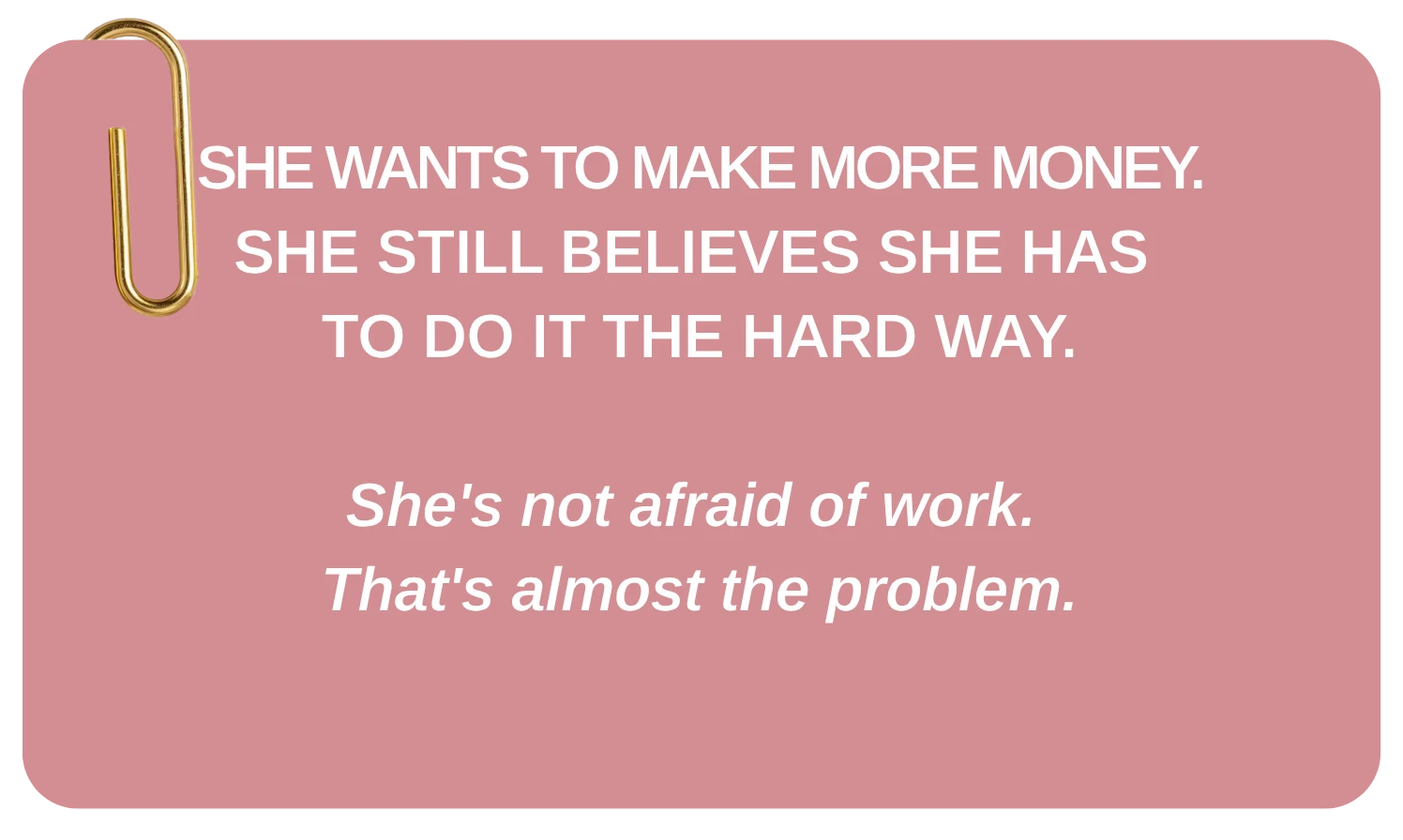
Assuming every extra dollar has to come from extra hours.
Feeling like she'll fall behind the moment she stops pushing.
Still feeling pulled toward doing more, even after she's shown she can do the job.
Working longer, trying harder, staying later, and never really switching off.
Believing the money only counts once she's suffered enough to earn it.
The Tax: Effort and Sacrifice.
Paid again and again, because she isn't sure what happens to the money if she stops.
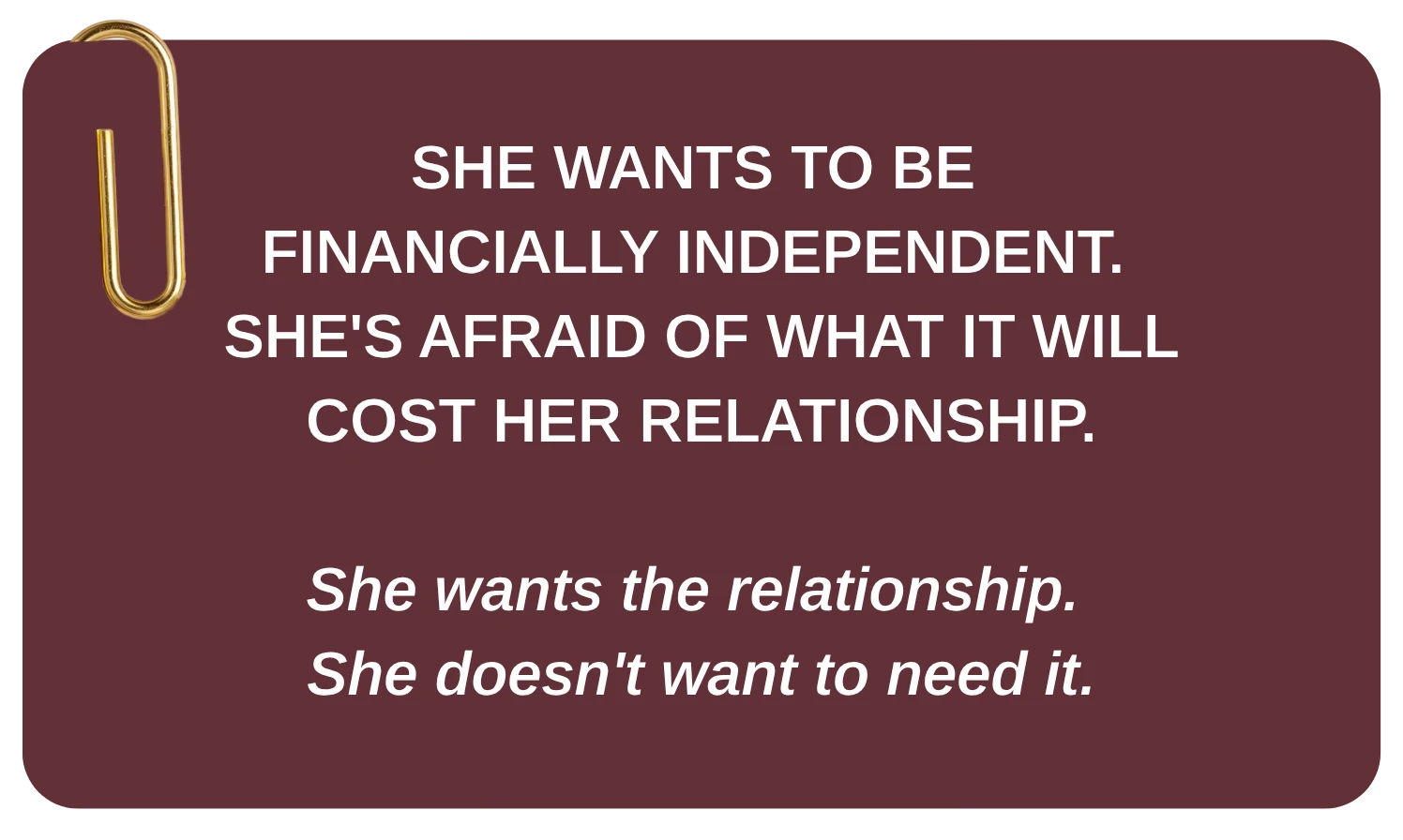
Asking herself if she'd still be in the relationship if money weren't part of the equation.
Resenting how dependent she feels and fearing what happens once she isn't.
Wanting to be able to support herself and feeling guilty for the support she still receives.
Deferring the final say to whichever one of them makes more money.
Wanting to know she could leave, and wondering what would happen if she really could.
The Tax: Relationship Security.
Risked every time she needs someone
else's money a little less.
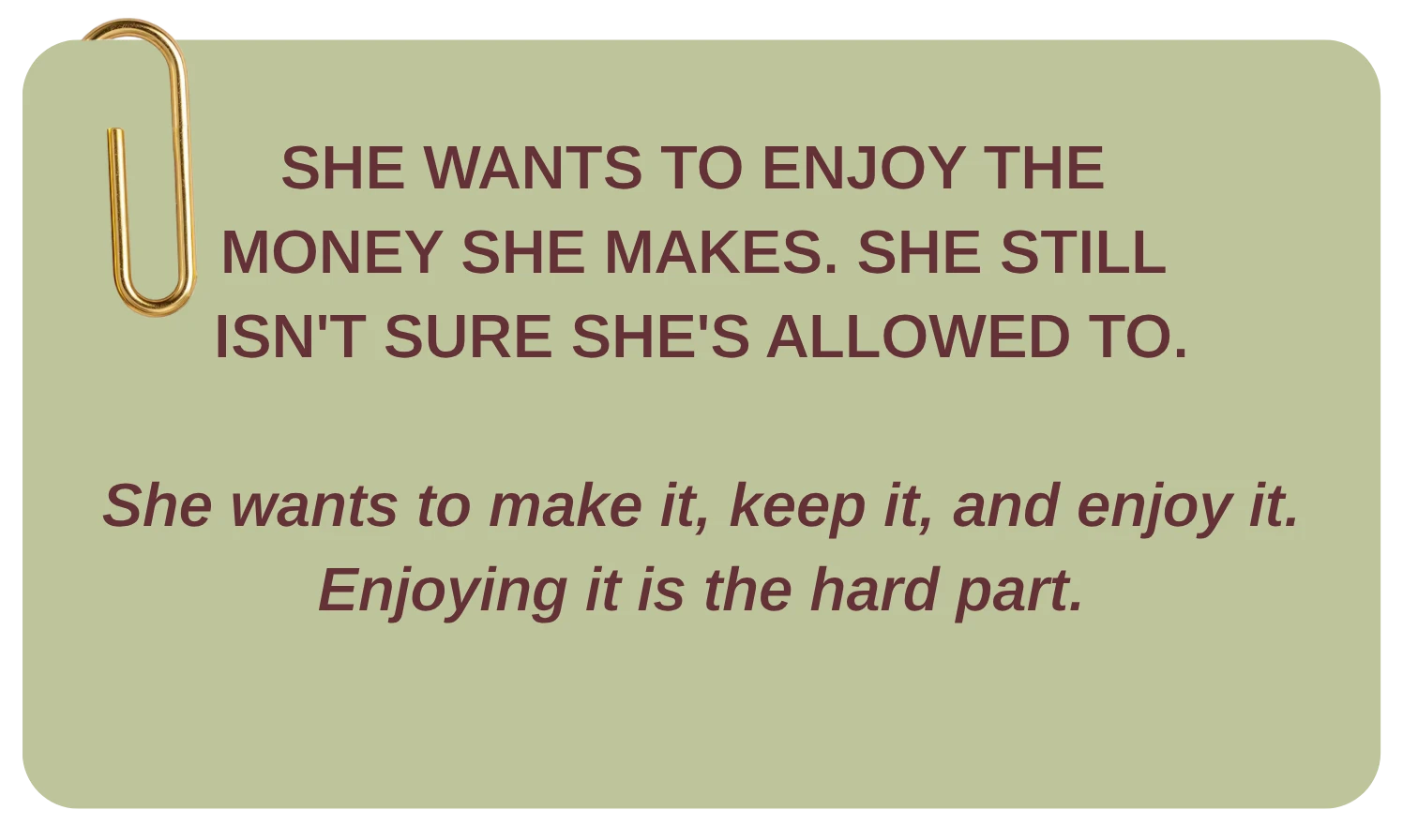
Needing a good enough reason before she lets herself want more.
Reminding herself how hard she worked, just to feel okay about the money she's made.
Wondering what it says about her if money makes her life this much easier.
Believing she doesn't deserve the money unless she's done something good with it.
Holding herself back from enjoying it when people she loves go without.
The Tax: Proof She Deserves It
Demanded again and again, no matter
how much she's already proved.
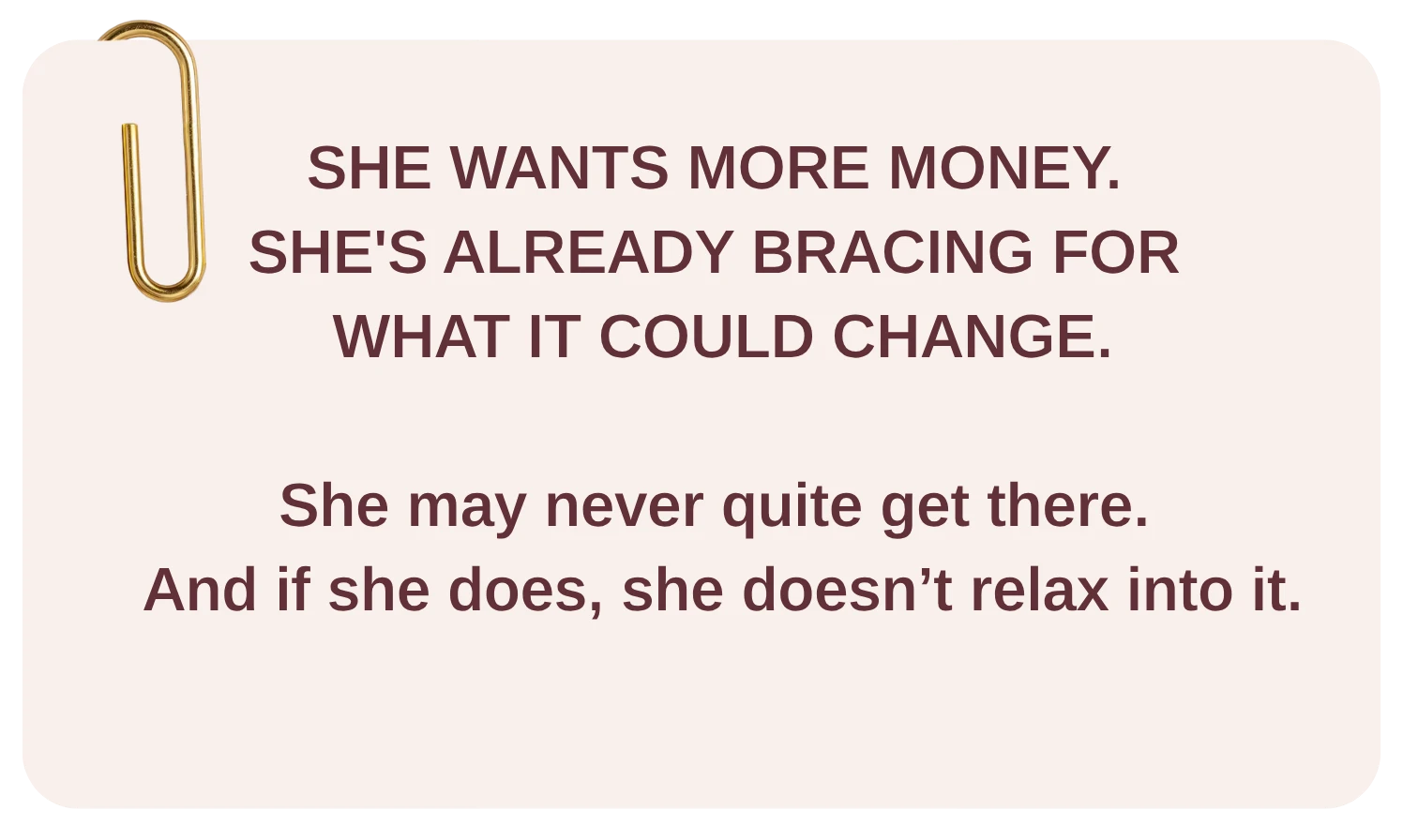
Worrying about what she'll be responsible for before she even has it.
Finding twelve reasons not to take the opportunity that scares her the most.
Deciding what her new money needs to do before she lets herself enjoy it.
Treating every unfamiliar part of having more like a risk to manage.
Wondering if she'll know how to handle a life with plenty of money in it.
The Tax: Vigilance and Responsibility.
Always turned on,
even when nothing is wrong.
Money doesn't just change her income.
It changes what she has to prove,
what people expect from her,
and how much of herself she has
to give to keep it.

Access to money isn't the same as experience with it. A woman can have one well before she has the other.
Women today have more financial choice than ever before. That's real progress, and it's also where the story gets complicated.
Women have had less time and fewer chances to learn by watching and doing. They build experience by having money of their own, making decisions with it, and seeing where those decisions lead. Every money decision someone else made for her was practice she didn't get.
She can close a deal, negotiate her rate, and read a budget line by line. Ask her what's actually in her investment accounts, and she may not be able to tell you.
There's a good reason for that. The rooms where this knowledge got passed down were built by men, for men, and for most of history, the vast majority of women weren't allowed anywhere near them.

The first woman to own a seat on the New York Stock Exchange did so in 1967. Congress prohibited credit discrimination based on sex or marital status in 1974. And some state laws still required women to have a male relative co-sign a business loan until 1988.
That history didn't stay in the past. Women are living it today. In the 2025 TIAA Institute-GFLEC study, women answered 45 percent of the financial literacy questions correctly, compared with 53 percent for men. On investing knowledge specifically, women scored 15 percentage points lower.
And it's not just what she knows. It's how sure she feels acting on it. In its 2025 survey, the Federal Reserve found that 39 percent of women felt comfortable choosing and managing investments, compared with 55 percent of men.
Some of that gap started early. For generations, schools steered girls into home economics. They learned to cook, sew, plan meals, and stretch a grocery budget, all real skills that kept families running. Economics, the kind that builds wealth, was left to the boys.
So most women earning a living today grew up learning to run a household, not an investment account. They still want more money and are willing to go after it. But access arrived first, and the knowledge and confidence to use it didn't come with it.
Access to money isn't the same as experience with it. A woman can have one long before she has the other.
Women today have more financial choice than ever before. That's real progress.
And more choice is where the story gets more complicated, because making money is one thing, but knowing what to do with it once she has it is another.
Women have had less time and fewer opportunities to learn through observation and practice. They build experience by having money of their own, making decisions with it, and learning from where those decisions lead. Those fewer reps show up in both their knowledge and their confidence.
She can close a deal, negotiate her rate, and read a budget line by line. Ask her what her own investment accounts are actually invested in, and she may not be able to tell you.
There's a good reason for that. The rooms where this knowledge got passed down were built by men, for men, and for most of history, the vast majority of women weren't allowed anywhere near them.
The first woman to own a seat on the New York Stock Exchange did so in 1967. Congress prohibited credit discrimination based on sex or marital status in 1974. And some state laws still required women to have a male relative co-sign a business loan until 1988.
That history didn't stay in the past. Women are living it today. In the 2025 TIAA Institute-GFLEC study, women answered 45 percent of the financial literacy questions correctly, compared with 53 percent for men. On investing knowledge specifically, women scored 15 percentage points lower.
And it's not just what she knows. It's how sure she feels acting on it. The Federal Reserve found that 39 percent of women felt comfortable choosing and managing investments, compared with 55 percent of men.
What it comes down to is that most women earning a living today were expected to run a household, not an investment account. And in spite of that, they've made it clear that they want more money and are willing to go after it. But for us, access arrived first. The knowledge and confidence to use it didn't come with it.
A woman may want her own money so she can make decisions without asking for permission. But earning it doesn't settle who gets to decide.
The inherited equation was simple. Men were expected to provide the money, and providers decided. Women were expected to keep everything else running, but that work never carried the same authority.
When a woman becomes the provider, she isn't stepping into an empty role. The authority attached to it was built around men. Using it can get her read as harder, more controlling, less giving, less caring, somewhere between a boss and a beast. The authority may be the same. The judgment can be different. The question is whether she can decide the way a provider decides and still be the woman she was raised to be.
If she brings in all the money, she may hold the weight of every decision and the judgment that comes with it. If she contributes a lot but isn't the sole provider, she may start measuring her voice against her paycheck, as though her authority rises and falls with her share of the income.
Meanwhile, the work she already does can still be treated as nonnegotiable. Nobody has to say it out loud for the message to land. Make more money, but don't let making it change anything substantial around here, including what gets done, who does it, how available you are, or who has to adjust.
And once she's the provider, she can reach for the same equation herself. I earned it. I carry the financial responsibility. I should have the final word.
That doesn't make her uniquely controlling. It shows how the provider can change while the rule stays put.
Money can give her leverage, independence, and more say in her own life. It doesn't give her ownership of another adult's authority.
Providing shouldn't require her to surrender her voice or give her the right to take someone else's.
A woman may want her own money so she can make decisions without asking for permission. But earning it doesn't settle who gets to decide.
The inherited equation was simple. Men were expected to provide the money, and providers decided. Women were expected to keep everything else running, but that work never carried the same authority.
When a woman becomes the provider, she isn't stepping into an empty role. The authority attached to it was built around men. Using it can get her read as harder, more controlling, less giving, less caring, somewhere between a boss and a beast. The authority may be the same. The judgment can be different. The question is whether she can decide the way a provider decides and still be the woman she was raised to be.
If she brings in all the money, she may hold the weight of every decision and the judgment that comes with it. If she contributes a lot but isn't the sole provider, she may start measuring her voice against her paycheck, as though her authority rises and falls with her share of the income.
Meanwhile, the work she already does can still be treated as nonnegotiable. Nobody has to say it out loud for the message to land. Make more money, but don't let making it change anything substantial around here, including what gets done, who does it, how available you are, or who has to adjust.
And once she's the provider, she can reach for the same equation herself. I earned it. I carry the financial responsibility. I should have the final word.
That doesn't make her uniquely controlling. It shows how the provider can change while the rule stays put.
Money can give her leverage, independence, and more say in her own life. It doesn't give her ownership of another adult's authority.
Providing shouldn't require her to surrender her voice or give her the right to take someone else's.
Having more money can change what a woman is able to do before it changes what she feels allowed to do.
Sometimes the question "Am I allowed to want this at all?" shows up before she's even made a dollar or admitted she wants it.
For women, money often comes with strings attached, and those strings aren't always visible. They show up in what it says about her to want it, what she'll owe once she has it, who she's letting down if she keeps it, and whether she gets to enjoy it.
Even asking to be paid well can feel dangerous. She may hold back when it's time to name her price, have the sales conversation, or admit she wants more than just enough.
Behind that fear is an invisible judge made up of family rules, cultural expectations, and every comment she ever heard about a woman who wanted too much. It's constantly measuring her against the scorecard she inherited, where a good woman takes care of everyone, stays grateful, and needs less. Her giving passes. Her receiving barely does. Her asking for what she wants and taking it gets a hard pass.
When money finally arrives, the discomfort doesn't leave. Even once it's hers, keeping it can bring fear and guilt. She may worry it won't last, hesitate to invest because the risk feels too great, or feel responsible for every financial problem she can afford to help resolve, even though having the means doesn't make every need hers to meet.
That's the money ick. Wanting money, receiving it, and letting it stay hers can rub against everything she learned makes a woman good.
Having more money can change what a woman is able to do before it changes what she feels allowed to do.
Sometimes the question "Am I allowed to want this at all?" shows up before she's even made a dollar or admitted she wants it.
For women, money often comes with strings attached, and those strings aren't always visible. They show up in what it says about her to want it, what she'll owe once she has it, who she's letting down if she keeps it, and whether she gets to enjoy it.
Even asking to be paid well can feel dangerous. She may hold back when it's time to name her price, have the sales conversation, or admit she wants more than just enough.
Behind that fear is an invisible judge made up of family rules, cultural expectations, and every comment she ever heard about a woman who wanted too much. It's constantly measuring her against the scorecard she inherited, where a good woman takes care of everyone, stays grateful, and needs less. Her giving passes. Her receiving barely does. Her asking for what she wants and taking it gets a hard pass.
When money finally arrives, the discomfort doesn't leave. Even once it's hers, keeping it can bring fear and guilt. She may worry it won't last, hesitate to invest because the risk feels too great, or feel responsible for every financial problem she can afford to help resolve, even though having the means doesn't make every need hers to meet.
That's the money ick. Wanting money, receiving it, and letting it stay hers can rub against everything she learned makes a woman good.

Before a woman turns a money problem into something wrong with her, she needs to know what she's dealing with, because not every money problem is a mindset problem.
Sometimes the problem is exactly what it looks like. She needs more money, childcare, capital, or time. Her business may need better pricing or stronger sales. Someone else may be making the financial decisions, and she may not have a say in how the money gets used or shared.
Financial abuse, coercive control, discrimination, and unsafe conditions aren't internal problems. Insight can't solve them. They call for resources, education, strategy, legal protection, or safety support.
At other times, the facts change and the discomfort remains. She can have enough and still struggle to use it, know what to do and still hesitate, or be free to decide and still feel she needs permission.
The problem may be an expectation she inherited, a response she learned while living inside it, or both. Some of it is mindset. Not all of it is.
The point isn't to hand every woman the same explanation. It's to help her tell which part is which, so she can respond to what's actually there instead of what she's been taught to assume.

Before a woman turns a money problem into something wrong with her, she needs to know what she's dealing with, because not every money problem is a mindset problem.
Sometimes the problem is exactly what it looks like. She needs more money, childcare, capital, or time. Her business may need better pricing or stronger sales. Someone else may be making the financial decisions, and she may not have a say in how the money gets used or shared.
Financial abuse, coercive control, discrimination, and unsafe conditions aren't internal problems. Insight can't solve them. They call for resources, education, strategy, legal protection, or safety support.
At other times, the facts change and the discomfort remains. She can have enough and still struggle to use it, know what to do and still hesitate, or be free to decide and still feel she needs permission.
The problem may be an expectation she inherited, a response she learned while living inside it, or both. Some of it is mindset. Not all of it is.
The point isn't to hand every woman the same explanation. It's to help her tell which part is which, so she can respond to what's actually there instead of what she's been taught to assume.

A woman should be able to receive support without surrendering authority over her decisions, provide for the people she loves without turning providing into control, and build financial independence without having to go it alone.
If she chooses partnership, it should be because she wants it, not because she needs it. Having enough money of her own is part of what makes that possible, because it removes one barrier to leaving. That doesn't mean she has to leave. It means that if she stays, it's because she wants to.
That's the freedom money can help create. It gives her more choice, so dependence and isolation aren't her only options.
Money can matter without deciding everything.
A woman should be able to receive support without surrendering authority over her decisions, provide for the people she loves without turning providing into control, and build financial independence without having to go it alone.
If she chooses partnership, it should be because she wants it, not because she needs it. Having enough money of her own is part of what makes that possible, because it removes one barrier to leaving. That doesn't mean she has to leave. It means that if she stays, it's because she wants to.
That's the freedom money can help create. It gives her more choice, so dependence and isolation aren't her only options.
Money can matter without deciding everything.
None of this is only hers to sort out.
Women are asked to develop extraordinary resilience in response to conditions that are consistently harder than they need to be. Then that resilience gets treated as proof that the conditions are acceptable.
But resilience only proves how much we can handle, not how much we should be expected to handle.
We shouldn't have to fight this hard just to reach the starting line for financial security.
And in spite of it all, we're still making it happen. We play the hand we're dealt and win anyway, and every dollar we earn, save, and invest makes the way easier for the women who come after us.
Imagine the doors that could open for us, for our children, for our relationships, if more of our strength could go toward building wealth instead of fighting for a fair chance to build it.
None of this is only hers to sort out.
Women are asked to develop extraordinary resilience in response to conditions that are consistently harder than they need to be. Then that resilience gets treated as proof that the conditions are acceptable.
But resilience only proves how much we can handle, not how much we should be expected to handle.
We shouldn't have to fight this hard just to reach the starting line for financial security.
And in spite of it all, we're still making it happen. We play the hand we're dealt and win anyway, and every dollar we earn, save, and invest makes the way easier for the women who come after us.
Imagine the doors that could open for us, for our children, for our relationships, if more of our strength could go toward building wealth instead of fighting for a fair chance to build it.

You've seen what happens between wanting money, going after it, and being able to hold on to it once it's yours.
You also have a name for the invisible judge that measures so many women against the scorecard they inherited.
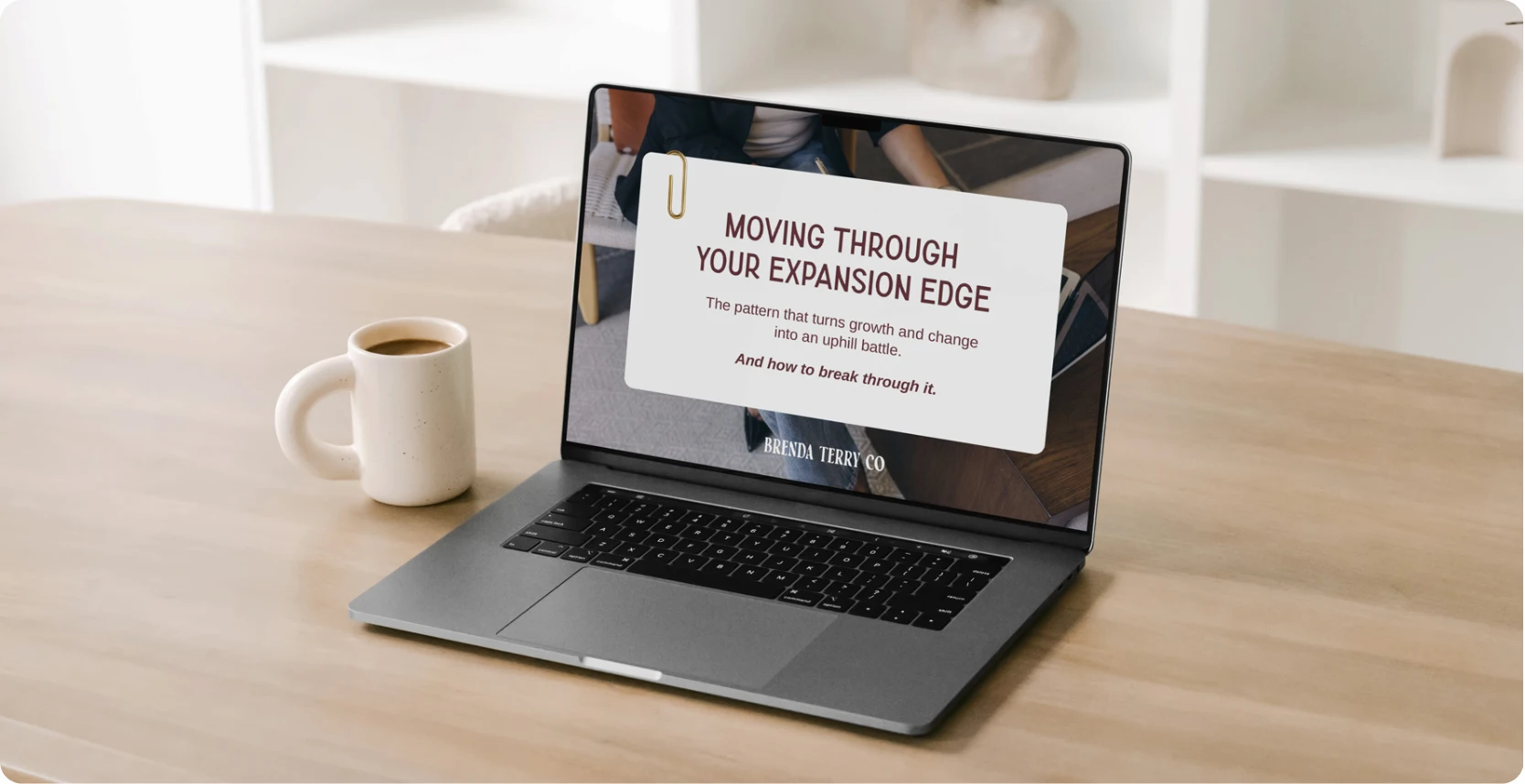
The free on-demand masterclass , Moving Through Your Expansion Edge, goes underneath all of it. It maps the pattern that turns growth and change into an uphill battle, including the growth that comes with more money. You'll see why pushing harder can keep you stuck and how to start moving through it.
This Perspective gave you language for money and power. The masterclass gives you the structure underneath it.
It's free, on demand, and ready when you are.

You've seen what happens between wanting money, going after it, and being able to hold on to it once it's yours.
You also have a name for the invisible judge that measures so many women against the scorecard they inherited.
The free on-demand masterclass , Moving Through Your Expansion Edge, goes underneath all of it. It maps the pattern that turns growth and change into an uphill battle, including the growth that comes with more money. You'll see why pushing harder can keep you stuck and how to start moving through it.
This Perspective gave you language for money and power. The masterclass gives you the structure underneath it.
It's free, on demand, and ready when you are.

You've seen what happens between wanting money, going after it, and being able to hold on to it once it's yours.
You also have a name for the invisible judge that measures so many women against the scorecard they inherited.
The free on-demand masterclass , Moving Through Your Expansion Edge, goes underneath all of it. It maps the pattern that turns growth and change into an uphill battle, including the growth that comes with more money. You'll see why pushing harder can keep you stuck and how to start moving through it.
This Perspective gave you language for money and power. The masterclass gives you the structure underneath it.
It's free, on demand, and ready when you are.
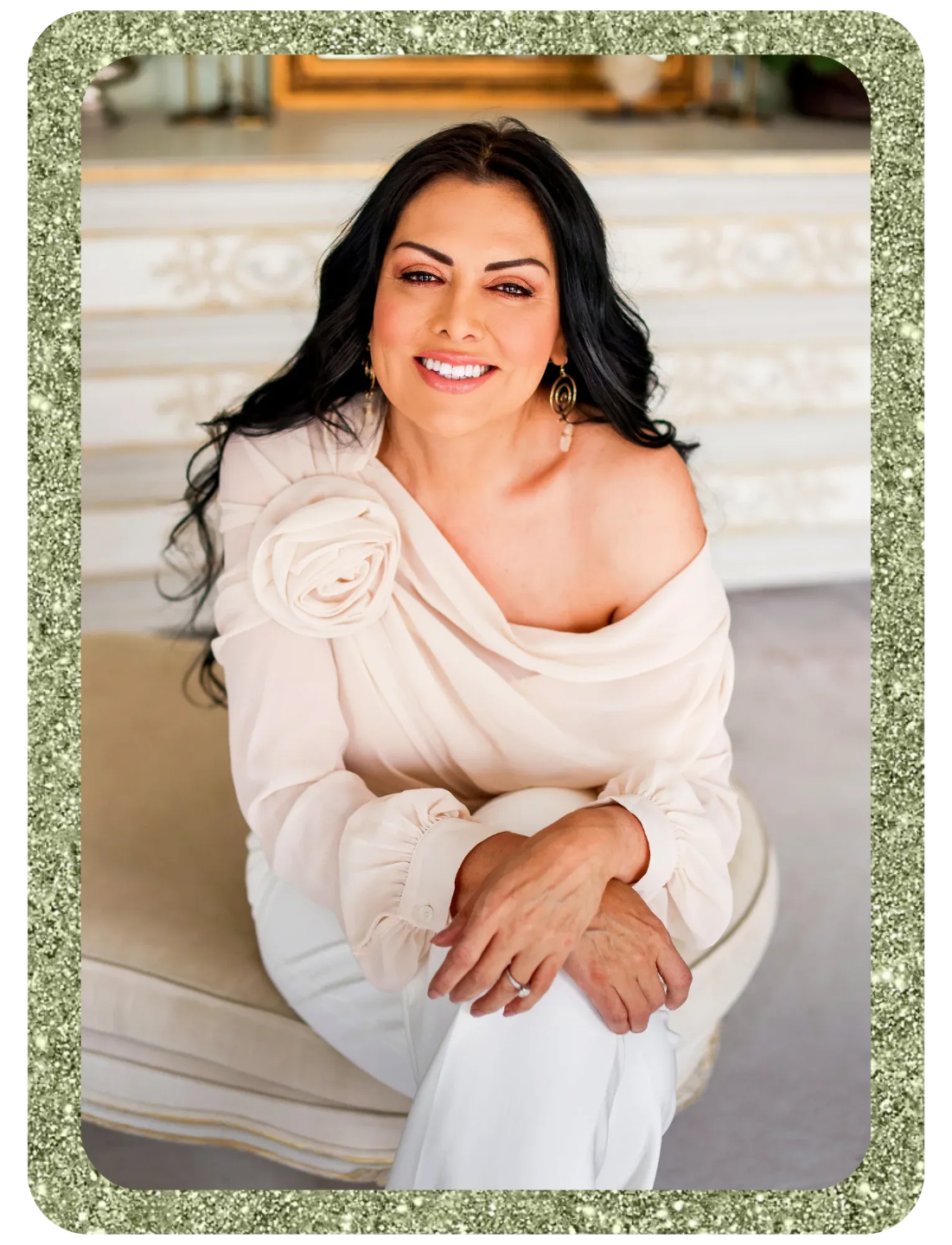
I’ve spent decades studying human behavior, emotional adaptation, and the patterns that influence how people move through their lives.
For the last ten years, my focus has been primarily on women in business. Women who lead, build, make difficult decisions, and create results while older rules still decide what feels safe, acceptable, or possible.
I created Breakthroughs Made Simple™ because I kept watching intelligent, experienced women hit invisible walls that had nothing to do with what they knew or how hard they were willing to work. While the problem often looked different, the pattern underneath was the same.
I came to this work from lived experience.
Growing up, I saw that for women, access usually came through someone else. Someone else had the money, the authority, or the power to decide what happened next. I brought that understanding into adulthood, business, and motherhood.
Today, I study what happens when women gain more access to money, authority, power, visibility, and choice, and what they do with it once it's actually theirs.
That’s what this work is built from.

I’ve spent decades studying human behavior, emotional adaptation, and the patterns that influence how people move through their lives.
For the last ten years, my focus has been primarily on women in business. Women who lead, build, make difficult decisions, and create results while older rules still decide what feels safe, acceptable, or possible.
I created Breakthroughs Made Simple™ because I kept watching intelligent, experienced women hit invisible walls that had nothing to do with what they knew or how hard they were willing to work. While the problem often looked different, the pattern underneath was the same.
I came to this work from lived experience.
Growing up, I saw that for women, access usually came through someone else. Someone else had the money, the authority, or the power to decide what happened next. I brought that understanding into adulthood, business, and motherhood.
Today, I study what happens when women gain more access to money, authority, power, visibility, and choice, and what they do with it once it's actually theirs.
That’s what this work is built from.
U.S. Census Bureau, Poverty in the United States: 2025 — poverty rates by sex and poverty among children in families headed by a woman with no spouse present.
National Women’s Law Center, Resources on Poverty, Income, and Health Insurance in 2024 — poverty rates for Black women, Latinas, and Native women.
U.S. Census Bureau, Income in the United States: 2025 — women’s median earnings as a share of men’s among full-time, year-round workers.
U.S. Department of Labor, Bridging the Gap for New Americans Final Report — barriers related to foreign credentials, English proficiency, licensing, and recredentialing.
Harvard Business School Baker Library, Muriel Siebert: Seat on the New York Stock Exchange, 1967 — Muriel Siebert became the first woman to hold a seat on the New York Stock Exchange in 1967.
Consumer Financial Protection Bureau, Equal Credit Opportunity Act — federal protections against credit discrimination, including discrimination based on sex or marital status.
National Women’s Business Council, Women’s Business Ownership Act of 1988 — legislation associated with eliminating remaining state requirements that women obtain a male relative’s or husband’s signature for certain business credit.
TIAA Institute and GFLEC, Financial Literacy and Retirement Fluency in America: Findings from the 2025 P-Fin Index — financial-literacy results by gender, including the reported difference in investing knowledge.
Federal Reserve, Economic Well-Being of U.S. Households in 2025: Savings and Investments — women’s and men’s reported comfort choosing and managing investments.
This free on-demand masterclass shows you why increased pressure, responsibility, or change can make what used to feel manageable take more out of you, what keeps that friction going, and how to move through it.
Breakthroughs Made Simple™ helps you resolve the emotional material and internal interference keeping a persistent problem or struggle active, so you can have more room, more choice, and a clearer way through.


Get started today before this once in a lifetime opportunity expires.